ERP vs. Siloed Software: Why Integration Is Everything
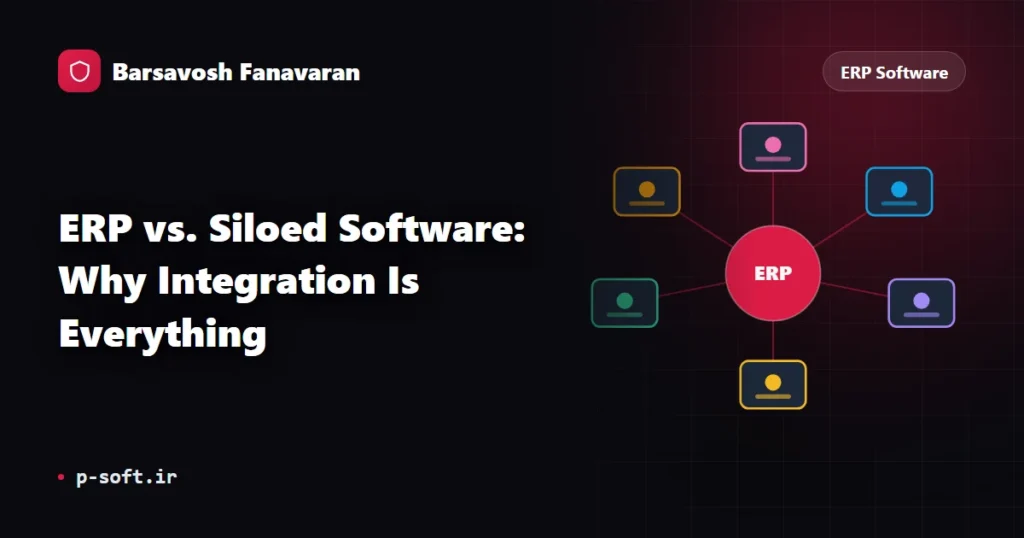
The fundamental difference between ERP and siloed software comes down to how data is owned and shared. In an ERP — an Enterprise Resource Planning system — every department works from a single shared database. In a siloed approach, each unit runs its own independent system with no connection to the others. Many businesses deploy a separate application for each function: one for accounting, one for inventory, one for sales. This article breaks down the precise difference between an integrated enterprise system and standalone software so you can decide which approach makes more business sense for you.
What Is Siloed Software?
Siloed software — also called standalone or island software — means each department operates its own separate tool and those tools never talk to each other. The natural consequence of this fragmentation is duplicate data, conflicting reports, and a constant need to manually transfer information between teams. A sales order, for example, must be entered once in the sales system, manually communicated to the warehouse, and entered again in accounting. Every step is a fresh opportunity for human error.
Integrated ERP vs standalone/island software (at a glance)
| Criterion | Integrated ERP (Data) | Standalone/island tools |
|---|---|---|
| Data consistency | One database, always in sync | Islands that drift and mismatch |
| Data entry | Enter once, used everywhere | Re-entered in each tool |
| Reporting | Real-time, organisation-wide | Manual and scattered |
| Long-term cost | Lower (one system) | Multiple licences + integration cost |
Data unifies finance, inventory, purchasing and sales in one platform.
How Is ERP Different from Siloed Software?
In an ERP system, every process connects to a single source of truth. The moment a sales order is placed, inventory levels drop automatically and the corresponding financial entry is created — no extra steps, no re-keying. Data stays synchronized, current, and consistent across the entire organization. Simply put, a comprehensive enterprise system builds one connected continent instead of a collection of isolated islands, letting managers monitor the whole business from a single vantage point.
ERP vs. Standalone Software: Head-to-Head Comparison
- Data integration: In ERP, data is entered once and used everywhere. In siloed systems, data is scattered and duplicated.
- Redundant entry: An integrated system eliminates re-keying; standalone systems require the same information to be entered multiple times.
- Management reporting: ERP delivers a real-time, unified view of the entire organization. A siloed approach demands manual merging of files and spreadsheets before every meeting.
- Errors and discrepancies: An integrated system dramatically reduces errors; mismatches between departmental figures are commonplace in siloed environments.
- Long-term cost: ERP requires a higher upfront investment but eliminates the hidden ongoing cost of maintaining several disconnected systems.
When Do You Need to Move from Siloed Systems to ERP?
Not every business needs ERP from day one — but certain warning signs make it clear that the right time to move to an integrated enterprise system has arrived. If you recognize any of the following, your siloed tools are likely no longer up to the job:
- Staff are spending a significant portion of their workday manually entering and reconciling duplicate data.
- Sales, inventory, and finance figures never agree, and reports have to be manually reconciled before every meeting.
- Rapid organizational growth means that each new department adds another layer of integration complexity.
- Decision-making has slowed because getting a real-time, unified picture of the business is simply too difficult.
In these circumstances, even if existing software can be connected through APIs and web services, the complexity and maintenance cost typically escalate to the point where a single integrated ERP becomes the more rational choice.
Common Mistakes When Choosing Between the Two Approaches
Organizations frequently fall into the same traps when deciding between an integrated enterprise system and standalone tools. Knowing these pitfalls upfront leads to a much better decision:
- Focusing only on sticker price: Ignoring the hidden cost of redundant work and maintaining multiple separate systems.
- Over-buying: Deploying a heavy-duty ERP in a small organization that has not yet reached the scale to justify it.
- Overlooking localization: Failing to account for the importance of an ERP that is compliant with local tax laws, accounting standards, and business regulations.
The Barsavosh Fanavaran (P-Soft) Solution
If you have concluded that integration is essential to your organization’s growth, choosing a locally built ERP that fits the realities of your business matters enormously. For factories, Data ERP brings sales, production, purchasing, inventory and finance together in one unified system — putting an end to the era of information silos in your organization. Note that tax calculation and e-invoicing are not part of Data ERP; they can be delivered as a custom project if needed. If your needs are highly specific and an off-the-shelf solution falls short, our team also offers custom software development and modernization to build a system precisely mapped to your processes. Contact us to request a demo.
Frequently Asked Questions
What is the main difference between ERP and siloed software?
In an ERP, all departments share a common database — information is entered once and available everywhere. In siloed software, each unit has its own system, leading to duplicated, inconsistent data that must be moved manually between teams.
Can standalone systems be integrated with each other?
To some extent, yes — through APIs and web services. But every additional system added raises the complexity and maintenance cost and introduces more failure points. An ERP delivers that same integration natively, by design.
When is the right time to migrate from siloed software to ERP?
When data volumes and inter-department inconsistencies become unmanageable, manual data entry starts consuming too much staff time, and consolidated reporting becomes genuinely difficult — that is the signal that it is time to move to an integrated enterprise system.
Is ERP only suitable for large enterprises?
No. Modern enterprise systems are delivered in modular form, so small and medium-sized businesses can start with only the modules they need and add more as the organization grows.
Is there a real advantage to using a locally built ERP?
Yes. A locally developed ERP is built to comply with domestic tax laws, accounting standards, and organizational structures. It also comes with local support and timely updates whenever regulations change — making implementation and long-term maintenance simpler and lower-risk.
Further reading
- What Is ERP? Complete Guide to Enterprise Resource Planning
- ERP Software Guide: Benefits and How to Choose the Right System
- How to Choose the Right ERP Software for Your Organization
Complete guide: ERP software
Have a project in mind?
The Barsavosh team is ready to design custom software and AI solutions for your business.
Contact us